

Description
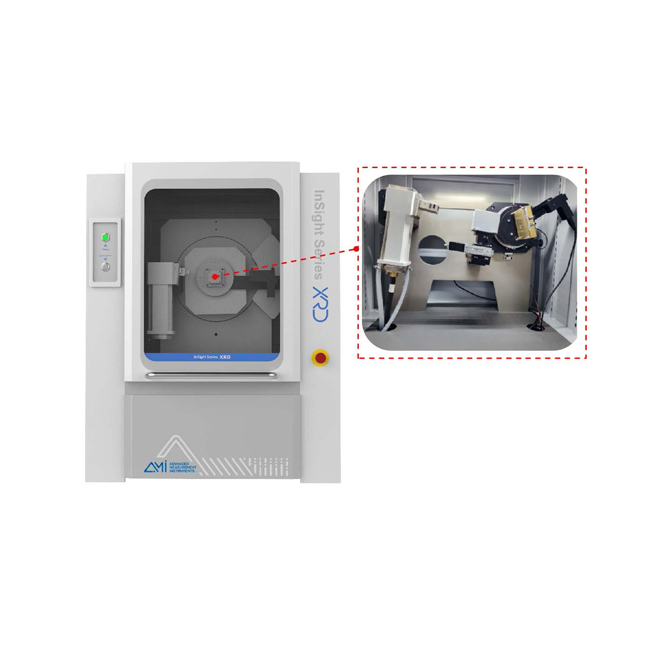
The InSight Series is a purpose-built in-situ transmission geometry X-ray diffractometer designed specifically for soft-pack (pouch) battery research. Instead of traditional reflection geometry, the system uses a vertical X-ray beam that penetrates through the entire pouch cell—capturing structural information simultaneously from both anode and cathode across the full cell thickness. The instrument is tailored for real-time monitoring of battery materials during charge/discharge cycles, ageing and thermal behaviour with temperatures ranging from -30 °C up to 300 °C.
Key Features
-
High-power 1600 W Molybdenum (Mo) X-ray source, optimized for penetration in pouch-type battery cells.
-
Photon-counting 2D array detector for high-resolution, low-noise diffraction data with fast scan capability.
-
Transmission geometry (X-ray beam enters one side of the pouch and exits the opposite side), enabling full-depth cell analysis (anode + cathode simultaneous).
-
Temperature-controlled sample stage covering approximately -30 °C to +300 °C, enabling investigation of thermal behaviour, degradation, failure modes, and operating conditions.
-
Precision goniometer (θ/2θ geometry) with radius ~144 mm for stable and accurate angular measurement.
-
Compact footprint (~900 mm × 680 mm × 550 mm) and approximately ~100 kg weight—designed for laboratory integration.
-
Compatible with electrochemical workstations to synchronously control battery cycling (charge/discharge) while acquiring XRD data.
Applications
-
In-situ structural analysis of soft-pack lithium-ion batteries (and other pouch-cell chemistries) during operation: phase changes, intercalation/de-intercalation, electrode evolution.
-
Thermal behaviour studies: effects of low-temperature start, high-temperature stress, thermal ageing, degradation mechanisms.
-
Simultaneous cathode + anode monitoring within a full cell format—capturing real-world battery behaviour rather than just single electrode or half-cell.
-
Research into novel battery materials, next-gen pouch cells (solid-state, high-energy density), and durability/lifetime investigation under cycling conditions.
Typical Specifications
-
X-ray tube power: ~1600 W, Mo target.
-
Geometry: θ/2θ, goniometer radius ~144 mm.
-
Detector: Photon-counting 2D array.
-
Maximum scanning range: ~0° to 150° 2θ.
-
Minimum step size: ±0.01° 2θ.
-
Temperature-controlled sample stage: ~-30 °C to ~300 °C (depending on configuration).
-
Footprint: ~900 mm (L) × 680 mm (W) × 550 mm (H).
-
Approximate weight: ~100 kg.
Why Choose This System?
-
Enables true in-situ transmission XRD of pouch cells—monitoring both electrode faces in one measurement.
-
Supports real-world battery formats (soft-pack) rather than just coin or small lab cells—so results are more representative of actual application.
-
Combines structural crystallographic data with electrochemical cycling to correlate performance with material changes.
-
Temperature range allows exploration of performance and degradation across the actual operating environment of batteries.
Considerations
-
The system is specialized for pouch/soft-pack format—if your research involves other cell types (cylindrical, prismatic, coin) you should verify compatibility.
-
Requires integration with a battery cycler/potentiostat if you want correlated electrochemical + structural data.
-
Sample preparation, cell mounting and alignment matter—especially for transmission geometry to avoid scattering artefacts.
-
Infrastructure: X-ray safety shielding and interlocks, temperature control (cooling/heating), and cell environment (gas, humidity) may need to be addressed.
-
While versatile, confirm that the temperature and scan speed suit your specific material/system (e.g., very fast cycling, extreme low temperature, solid-state cells) to maximise value.
0.0 Average Rating Rated (0)