
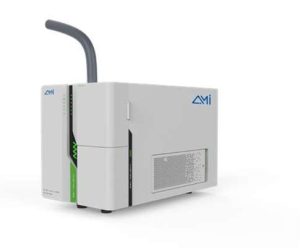


Description
The Master 400 is a high-resolution, desktop-sized quadrupole mass spectrometer developed by AMI Instruments (launched in 2022). It is intended for fast, accurate analyses of gas-phase components — either online (real-time) or offline — in a variety of systems such as chemisorption analyzers, microreactors, breakthrough curve analyzers, or thermal analyzers (TGA/STA).
Key Features
-
A temperature-controlled inlet pipeline to avoid condensation of gases during sampling.
-
A bakeable mass-spectrometry chamber (heatable to ~200 °C) to reduce background gases and improve signal quality.
-
Dual detectors (Faraday cup + electron multiplier) enabling a broad dynamic range from full concentration down to parts-per-billion sensitivity.
-
Rapid scanning and response (scan times as fast as ~1 ms per amu) for fast kinetics or transient monitoring.
-
A customizable sampling system with options for multichannel detection, automatic control and integration with other instruments.
-
A vacuum system combining a turbomolecular pump and an oil-free diaphragm (dry) pump, with full-range pressure monitoring and baking capabilities.
Typical Specifications
-
Mass range: 1-100 amu (optional up to 200 or 300 amu)
-
Detection limit: better than ~500 ppb
-
Scan rate: ~1 ms to 16 s per amu
-
Sampling rate: ~0.5 bar to ~1.5 bar input pressure (standard)
-
Maximum heating temperature for sample tube: ~200 °C
-
Maximum chamber bake temperature: ~200 °C
-
Filament material: Iridium
-
Detectors: Faraday cup + SEM (electron multiplier)
-
Interface: Ethernet (TCP/IP) for integration and automation
Applications
-
Coupling with chemisorption analyzers: to monitor gas streams (e.g., during TPD, TPR, TPO) in real time and intervene in reaction pathways or catalyst behavior.
-
Integration with reactor systems: enabling real-time gas composition analysis of reaction products, kinetics, or transient events in microreactors or pilot setups.
-
Connection with breakthrough curve analyzers: for adsorbents/separations work, tracking outgoing concentrations of multiple species dynamically.
-
Working with thermal analyzers (TGA/STA): monitoring evolved gases during heating or reaction, for polymers, composites, catalysts or materials decomposition.
-
General gas-analysis tasks: battery manufacturing (gas purity/venting), fuel cell exhaust gas monitoring, hydrogen/CO₂ purity, CVD processes, environmental or industrial monitoring.
Benefits
-
Combines high sensitivity and fast response in a relatively compact desktop format compared to large mass spec systems.
-
Deep integration capability: designed to work seamlessly as part of larger characterization apparatus, enabling richer data sets (composition + kinetics + surface behavior).
-
Reduced background noise and improved reliability through chamber baking and controlled inlet design.
-
Flexibility in operation (online/offline, multi-channel) and in integration via software and automation.
Considerations
-
Proper infrastructure is required: vacuum systems, appropriate gas handling (for sample inlets), safe exhaust and calibration gases.
-
For optimal performance, sample lines, filters, and heating jackets must be carefully managed to avoid condensation or delays.
-
Although compact for a mass spectrometer, users must still consider space, safety (radiation/gas), and maintenance (filament replacement, vacuum upkeep).
-
Selection of mass range (100/200/300 amu) and detector options should align with your analytical targets (e.g., heavier fragments or multi-component gases).
-
Operator expertise in mass-spectrometry, peak interpretation, and coupling with other instruments (e.g., chemisorption or reactor systems) will maximize value.
0.0 Average Rating Rated (0)