
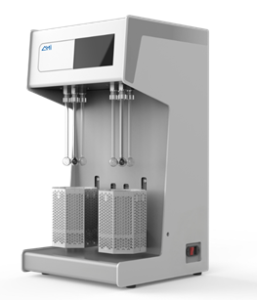


Description
The Prep J degasser is designed for efficient and controlled preparation of powder or particulate samples prior to surface-area and porosity analysis. With programmable temperature control, vacuum or flow modes, and multi-sample capability, the system ensures consistent degassing of multiple samples under stable and reproducible conditions.
Key Features
-
Programmable furnace with a temperature range from ambient up to approximately 400 °C, offering ±1 °C control accuracy.
-
Multi-port configuration (4-port or 8-port) for simultaneous degassing of multiple samples and higher laboratory throughput.
-
Built-in vacuum system with a multi-stage pump and pressure monitoring to prevent loss of fine powders during evacuation.
-
Flow-degasser variant available for inert-gas flow operation, ideal for vacuum-sensitive or delicate materials.
-
Compact benchtop design with integrated sample holders and an intuitive user interface for easy method setup.
Typical Specifications
-
Temperature range: Room temperature to ~400 °C
-
Control accuracy: ±1 °C
-
Degassing ports: Up to 8-sample capacity (depending on model)
-
Ultimate vacuum: Around 10⁻² Pa (for vacuum models)
-
Dimensions / Weight: Approximately 430 mm × 405 mm × 725 mm; ~36 kg for an 8-port vacuum unit
Applications
-
Sample activation by removing moisture, volatiles, and adsorbed gases before BET surface-area or porosity measurement.
-
Pretreatment of catalysts, adsorbents, and porous materials to ensure reproducible surface conditions.
-
Laboratories requiring simultaneous degassing of multiple samples under controlled temperature, vacuum, or inert-gas flow.
-
Academic, industrial, and QC laboratories seeking reliable and repeatable sample preparation.
Why Choose This System
-
Ensures reproducible surface analysis results by standardizing the degassing process.
-
Increases laboratory productivity with multi-sample operation.
-
Offers flexibility between vacuum and flow modes for various material sensitivities.
-
Compact, efficient, and easy to integrate into routine analytical workflows.
Considerations
-
May require supporting infrastructure such as vacuum pumps, gas supply, and exhaust systems depending on configuration.
-
Correct sample handling and ramp-rate control are essential for accurate results.
-
Selecting the appropriate model (number of ports, temperature range, degassing mode) is crucial for efficiency.
-
Operator training helps optimize methods for delicate or high surface-area materials.
0.0 Average Rating Rated (0)