
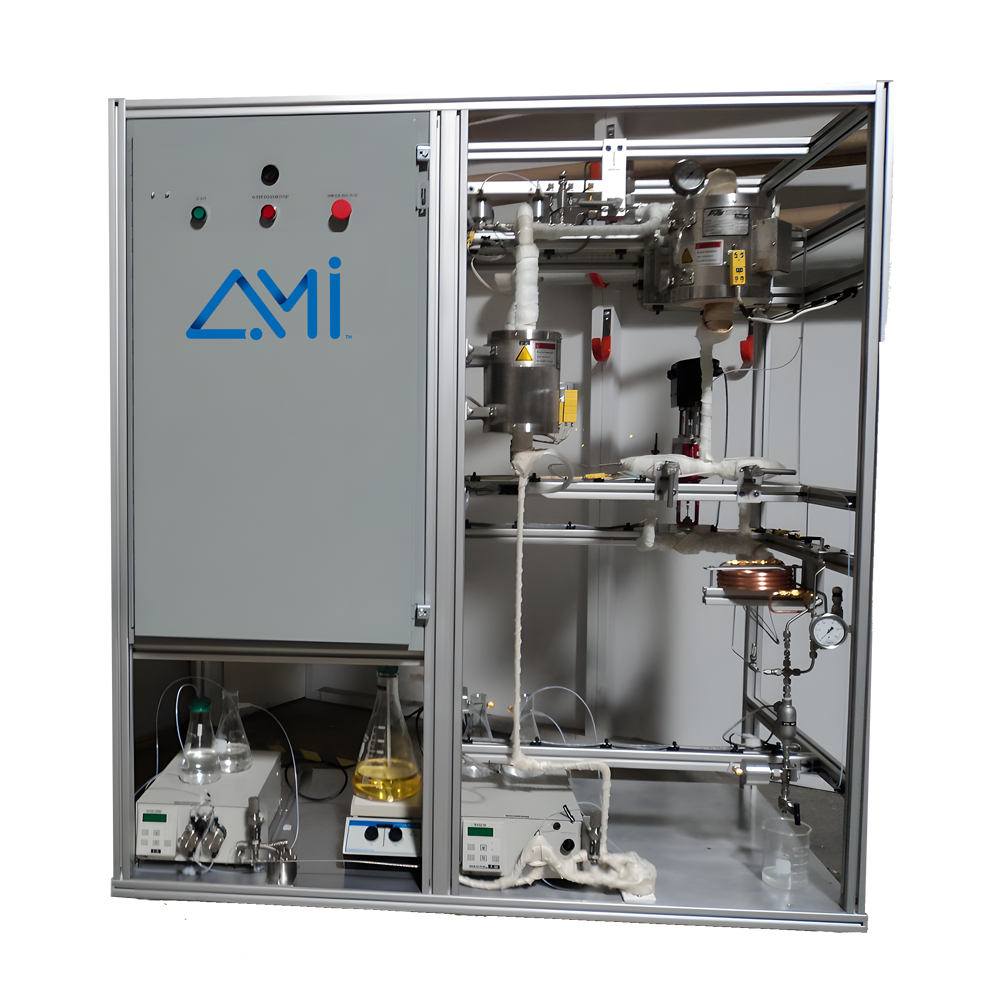

Description
The BenchCAT series offers fully automated, customizable reactor systems tailored for advanced biofuel production research. These systems are designed to accommodate a wide variety of feedstocks, processes and reaction conditions — making them suitable for cutting-edge studies in sustainable fuel generation.
Key Features
-
Highly flexible design configurable for gases and liquids, catering to different biofuel-production pathways (e.g., gasification, alcohol condensation, trans-esterification).
-
Support for multiple feed streams (gases and/or liquids), with dedicated preheating, vaporization and separation modules integrated.
-
Wide range of pressure and temperature capabilities to mimic industrial-scale conditions — e.g., elevated pressures, high temperature reactors, robust materials construction.
-
Automated control including mass flow controllers, liquid feed pumps, high-precision temperature control, component separation and product collection systems.
-
Customizable reactor material (e.g., stainless steel, Inconel, etc) for thermal and chemical robustness in harsh conditions.
-
Optional downstream separators and product collection stages configured for hydrocarbon waxes, mid-range liquids, water, and gases—all integrated with the reactor.
Common Application Pathways
-
Via Gasification of Biomass
Biomass (wood chips, municipal waste, cellulosic grasses) is gasified into syngas (H₂ + CO), then processed via a Fischer–Tropsch type reactor to produce fuels.
Example reactor: up to ~400 °C and ~1,500 psig (≈100 bar) with multiple gas feeds, three-stage separators for products (waxes, mid-range hydrocarbons, lighter gases + water). -
From Alcohols
Bio-alcohols (from starch or sugar fermentation) are fed into a liquid/gas reactor system for catalytic condensation (e.g., over zeolites like ZSM-5) transforming them toward gasoline-range products.
The reactor includes liquid feed pump, pre-heater/vaporizer, gas feed, high-pressure reactor, and automatic separation of liquid and gas phases. -
Via Trans-Esterification
Oils or lipids (such as used vegetable oil, algae oil, soy-bean oil) are reacted with alcohols (e.g., methanol) inside a catalytic or supercritical reactor to yield biodiesel or advanced biofuels. Reactor Conditions: e.g., ~350 °C, ~350 bar or up to ~700 °C at atmospheric depending on catalyst pretreatment and system design.
Why Choose This System?
-
Enables realistic simulation of commercial biofuel processes at laboratory or pilot-scale conditions.
-
Automates complex feed, reaction, separation and product capture workflows—reducing manual intervention and improving reproducibility.
-
Designed for versatility—whether your research involves biomass gasification, alcohol conversion, esterification or hybrid routes.
-
Provides a robust platform for catalyst testing, reaction optimization, process intensification and scale-up evaluation in sustainable fuel research.
Considerations
-
Infrastructure requirements are significant: high-pressure gas/liquid feeds, safety systems for high-temperature/pressure operations, effluent handling and product separation.
-
Reactor configuration (temperature, pressure, feed types, separation stages) needs to be aligned with the bio-fuel pathway under study to maximise value.
-
Operator training and method development are essential, especially because of the custom nature of each system and the complexity of integrated reaction/separation loops.
-
Because each system is tailor-designed, cost and lead-time will depend heavily on your specific process requirements (e.g., number of feeds, pressure rating, materials, separators, control modules).
0.0 Average Rating Rated (0)