
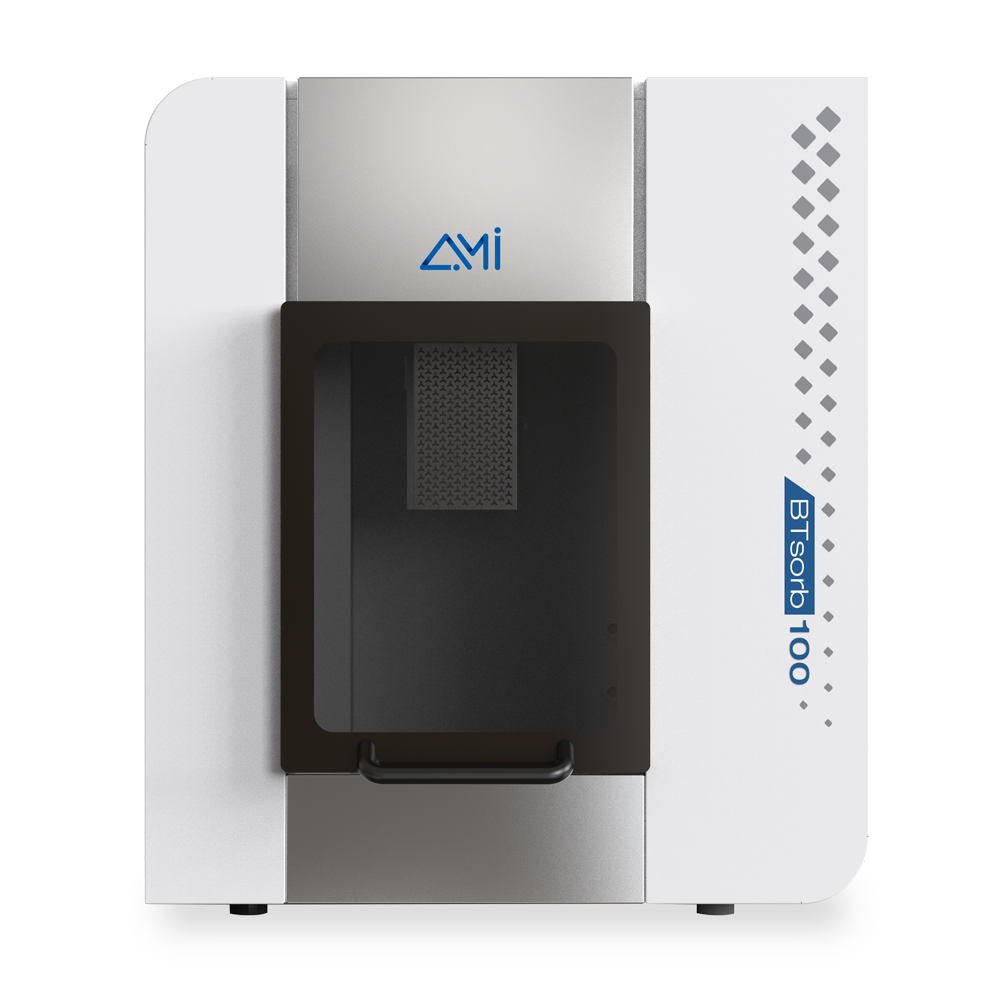

Description
The BTsorb 100 Series is a dynamic sorption analyzer specifically designed for breakthrough-curve testing, competitive adsorption, and mass-transfer kinetics of porous materials. It combines the capability to perform realistic separation/adsorption studies (gas/vapor mixtures) with automated software control and high-precision instrumentation.
Key Features
-
Multiple operation modes: supports several breakthrough/competitive adsorption modes plus dedicated diffusion-coefficient modes.
-
Automated, user-friendly software (BTManager) with custom test sequence programming, automatic data recording, flow calibration, and anomaly detection.
-
Flexible gas and vapor handling with multi-port inlets and optional vapor generators for controlled vapor dosing.
-
Robust thermal control: ambient to elevated column temperatures, optional water-bath cooling for sub-ambient, optional furnace for high-temperature.
-
Configurable pressure rating variants: from atmospheric up to tens of bar for higher-pressure models.
-
Detector options: standard high-precision Thermal Conductivity Detector (TCD); optional Mass Spectrometer for advanced analyses.
-
Column configurations: standard stainless-steel columns; optional quartz or zero-length-column (ZLC) style for fast diffusion measurements.
Applications
-
Evaluation of adsorbent performance (e.g., MOFs, zeolites, activated carbon) in gas separation, CO₂ capture and purification workflows.
-
Breakthrough curve experiments for single or mixed adsorbates under dynamic flow conditions.
-
Determination of diffusion coefficients and kinetics for adsorption/desorption processes (e.g., zero-length column method).
-
Cyclic adsorption studies, temperature-swing or pressure-swing adsorption processes, and multi-component separation assessments.
Typical Specifications (representative)
-
Modes: Breakthrough & Competitive Adsorption (≈5 modes) + Diffusion Coefficient Modes (≈2 modes).
-
Gas inlets: Standard 4 ports (1 carrier + up to 3 adsorbate) – optional expansion.
-
Vapor dosing: Up to 2 vapor generators (temp range approx. –10 °C to 90 °C).
-
Temperature control: Standard heating module ~ambient to ~400 °C; optional water-bath cooling (–10 °C to 90 °C); optional furnace to ~1000 °C.
-
Pressure range (varies by model variant): Atmospheric up to ~10 bar / ~40 bar / ~100 bar.
-
Detector: Standard TCD; optional MS (100 amu-200/300 amu).
-
Standard column volumes: 1 mL & 4 mL stainless steel; optional quartz or ZLC style.
-
Sample or system footprint: Approx. 820 mm × 820 mm × 880 mm (~200 kg weight) for standard variant.
Why Choose It?
-
Provides real-world dynamic adsorption/flow experiments, not just static isotherms—making it valuable for separation research and material screening.
-
Offers a balance between cost-effectiveness and advanced capability: suitable for labs needing dynamic sorption insight without full pilot-plant scale equipment.
-
High automation and software support reduce operator burden and enhance reproducibility.
-
Flexible configuration lets you match the instrument to your specific research needs (e.g., pressure range, vapor dosing, diffusion studies).
Considerations
-
Requires a lab infrastructure capable of supporting flow systems, gas/vapor handling, safety ventilation for streams with reactive or adsorbate gases.
-
Sample preparation (column packing, carrier gas/degas protocols) and system zeroing/calibration are critical to obtain reliable data.
-
While the system has broad capability, selecting the correct model variant (e.g., pressure rating, temperature limits, vapor option) is important to avoid over- or under-investment.
-
Interpretation of dynamic sorption/breakthrough data demands understanding of mass-transfer, kinetics, and separation theory beyond simple adsorption metrics.
0.0 Average Rating Rated (0)