
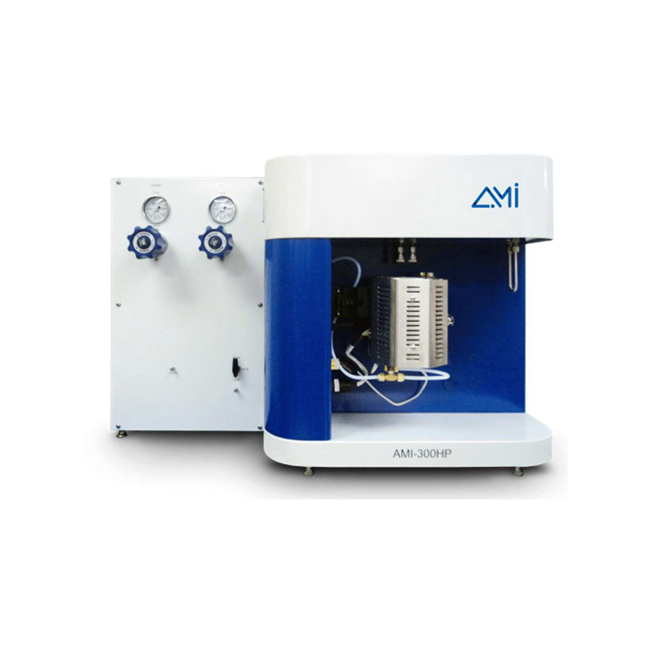

Description
The AMI-300HP is an advanced, fully-automated chemisorption analyzer designed for high-pressure catalyst characterization and reaction studies. It builds upon the proven AMI-300 platform, extending capabilities to operate at elevated pressures and temperatures, making it ideal for demanding catalytic and materials research applications.
Key Features
-
High-pressure capability (up to ~100 bar standard, with higher pressures available via custom configurations).
-
Wide temperature range (ambient to ~1200 °C, with optional sub-ambient start down to ~-130 °C).
-
Supports a broad array of analytical modes including:
-
Temperature-Programmed Reduction (TPR) / Oxidation (TPO) / Desorption (TPD)
-
Pulse chemisorption
-
Catalyst treatment & activation
-
Optional Dynamic BET surface area measurement
-
High-pressure isothermal reaction studies and vapor/liquid-phase reaction modes (with the RHP variation)
-
-
Fully automated control of valves, gas flows, temperatures, and detectors; experiments can be sequenced (up to 99 steps) and saved for repeatable use.
-
Robust hardware features: clamshell furnace, high-precision mass flow controllers (MFCs), heat-traced lines, inert flow path, and a linear thermal conductivity detector (TCD) as standard.
Typical Specifications
| Parameter | Typical Value |
|---|---|
| Catalyst Charge | ~0.1 – 1 g (custom reactors allow higher loadings) |
| Temperature Range | ~-130 °C to ~1200 °C (with options) |
| Ramp Rate | ~1 °C to ~50 °C/min |
| Operating Pressure | Up to ~100 bar (standard) |
| Gas Inputs | Typically 4–5 MFCs (carrier, treatment, pulse, etc.) |
| Detector | 4-filament TCD (filament options: W, Au/W, etc) |
Applications
-
High-pressure chemisorption and catalytic reaction testing such as hydrogenation, CO/CO₂ conversion, or fuel-cell catalyst evaluation.
-
Time-programmed studies of active metal dispersion, oxidation/reduction behavior, and surface reactivity under realistic operating pressures.
-
Catalyst activation/pretreatment sequences followed by reaction testing in a single instrument (reducing offline handling).
-
Advanced R&D requiring high throughput and accurate, reproducible data under elevated pressure and temperature conditions.
Why Choose This System?
-
Combines chemisorption, TPR/TPO/TPD, and reaction-measurement capabilities in one high-pressure platform.
-
Enables experiments that replicate realistic process conditions (higher pressure, higher temperature) rather than just ambient characterization.
-
Fully automated control and sequencing increase reproducibility, reduce operator burden and enable unattended operation.
-
Flexible options and customisation mean the instrument can grow with research needs (e.g., higher pressure, liquid feeds, vapor dosing, larger reactor loads).
Considerations
-
Because of its advanced capabilities, your lab must support the necessary infrastructure (gas supplies, high-pressure plumbing, safety valves, ventilation/exhaust, etc.).
-
Operator training is crucial, particularly for high-pressure experiments and data interpretation (chemistry under pressure is more complex).
-
Custom options (e.g., reactor materials, larger samples, liquid feeds) will drive cost and may require longer lead times.
-
Ensure the configuration selected (pressure rating, temperature range, reactor material compatibility, detector capabilities) matches your specific experimental needs to optimise cost-benefit.
0.0 Average Rating Rated (0)