
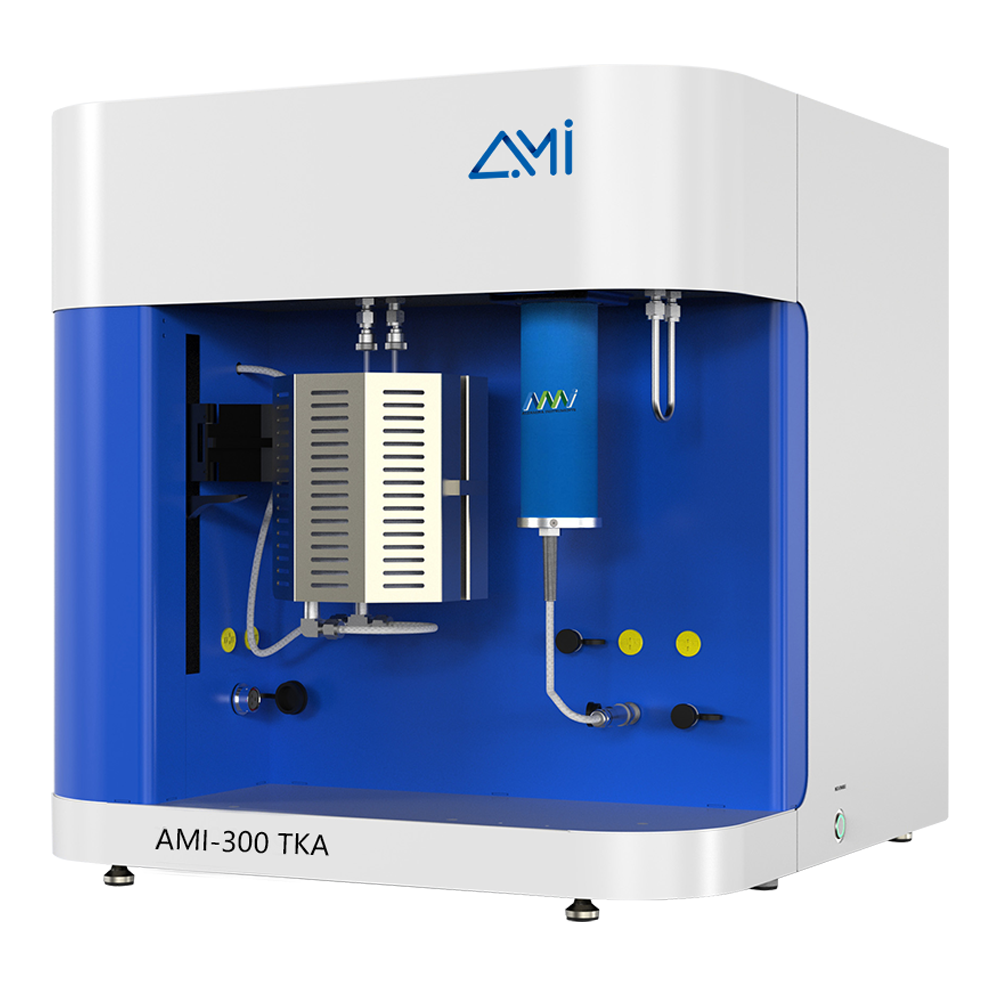

Description
The AMI-300 SSITKA is a high-performance automated chemisorption analyzer integrated with Steady-State Isotopic Transient Kinetic Analysis (SSITKA) capabilities. Compared with conventional chemisorption systems, it uses an isotopic tracer switch technique to probe reaction mechanisms, enabling real-time tracking of reactant/product dynamics, kinetic parameters, and catalyst active site behaviour under true steady-state conditions.
It supports a full suite of chemisorption and catalyst characterisation methods including:
-
Temperature-Programmed Desorption (TPD)
-
Temperature-Programmed Reduction/Oxidation (TPR/O)
-
Temperature-Programmed Surface Reaction (TPSR)
-
Pulse chemisorption
-
Dynamic BET surface area measurement
-
Optional vapor dosing
Key Features
-
Precision mass-flow control system with high-accuracy MFCs (flow rates from ~2 to 100 sccm)
-
High-stability furnace for temperature programming up to ~1200 °C (with linear ramp from ~0.1 to 50 °C/min, ±0.1 °C regulation)
-
Cold-trap and heated valve/line oven (to ~150 °C) ensure minimal condensation and dead-volume effects
-
Minimal dead-volume 1/16″ plumbing and rapid valve switching for accurate isotopic transient response
-
Safety features: over-temperature cut-off, pressure relief valves, configurable hardware alarms
-
Standard high-precision Thermal Conductivity Detector (TCD) with options for auxiliary detectors (mass spectrometer, FTIR, GC)
-
Software capable of programmable sequences (up to 99 steps), peak fitting, kinetics and mechanism extraction
Typical Specifications
| Specification | Value |
|---|---|
| Catalyst charge | ~0.1 – 5 g (depending on sample tube) |
| Temperature range | Standard: Room Temp → 1200 °C Optional sub-ambient: ~-130 °C → 1200 °C |
| Heating rate | ~0.1 – 50 °C/min |
| Gas flow range | ~2 – 100 sccm |
| Gas inlets | Up to ~12 (for isotopic switching, etc) |
| Detector | TCD standard; MS or other options available |
| Reactor types | Quartz u-tubes (e.g., 6 mm, 8 mm, 10 mm) |
Applications
This instrument is ideal for advanced catalyst research including:
-
Mechanistic studies of reactions (e.g., CO/13CO, N₂/15N₂, O₂/18O₂ switching) and catalyst surface intermediate lifetimes
-
Quantitative analysis of kinetic parameters, parallel reaction pathways and active-site behaviour
-
Catalyst activation, deactivation and treatment protocols combining TPD/TPR/TPSR and isotopic tracing
-
Dynamic BET and pulse chemisorption for metal dispersion, adsorption strength, and catalyst surface area
Why Choose This System
-
Enables in-situ isotopic tracer experiments under steady state for deep mechanistic insight
-
Combines automation, high precision, and advanced analytics in a single platform
-
Minimal dead volume and rapid switching support high temporal resolution of transient response
-
Broad flexibility for chemisorption, reaction kinetics, and surface characterisation in one instrument
Considerations
-
Due to its advanced capabilities, the system requires robust lab infrastructure (gas handling, auxiliary detectors, exhaust, etc.)
-
Operator training is important to set up isotopic experiments and interpret complex transient data
-
Ensure the configuration (temperature range, isotopic switching hardware, detectors) matches the specific research needs
0.0 Average Rating Rated (0)